
Current State
Maturity of SCADA systems are scattered across the Power & Energy Industry. It has broken into below 5 levels.
Maturity 0: No SCADA system at all.
Maturity 1: Standalone partial SCADA system i.e. acquisition capability exists but lacks distribution. Certain forms of data quality and security protocol may exist. Basic UI to set the control parameters and take reading. PLC exist to control predefined parameters such as flow
control, open and close valve.
Maturity 2: Complete SCADA system i.e. data acquisition and distribution. Certain form of data quality and security protocol may exist. Edge data storage capability with alert mechanism. Remote monitoring and RUI.
Maturity 3: SCADA interconnected with other systems(IoT sensors, Cloud, AI, ERP, etc) for further processing. Good level of data quality and security protocol may exist. Advance UI with real time analytics and reporting capability. Robust network and communication protocol to reduce latency, even while scaling with sensors data.
Maturity 4: SCADA has advanced levels of analytics such as avoiding safety alert fatigue. Software can control in real time to control the assets.
Proposed Future Vision :
Continuing on above maturity level, proposal is next level of maturity –
Maturity 5: Agentic Unified SCADA system such as self-healing monitored assets.
Key Argument : We can’t have centralized SCADA for a nation or region. It has to be
decentralized to accommodate the changing landscape of industry such as for energy
incorporating renewables, AI, etc.
Let’s unpack the why behind the above vision.
Why a Unified SCADA system at National Level?
A unified SCADA system doesn’t mean the same SCADA system used across the nation. It will be highly practical and easily end up in years of project to standardize on SCADA and then redoing further downstream.
Unified SCADA means it should follow below standards in terms of interconnection protocols, security, data privacy and data quality standard as a baseline. This will help in creating an easily unified layer of SCADA at nation level. Further, adding advanced AI technology such as LLMs, Agentic workflows, GenAI, will be easy. It will also lay down the foundation of creating digital twin.
Why the Agentic SCADA system?
Recent development in AI has proven to practically improve efficiency by removing waste what we formally called lean methodology. Fundamental idea is to understand the current process, identify the critical functionality that can be converted to agentic workflow to for example reduce latency. Another approach is to innovate existing processes completely using Agentic workflow to get exponential ROI.
Optimizing resource consumption.
Reduces downtime.
Why Modern SCADA?
Traditional SCADA was ground baking in certain industry like this. However, due to advancement in the technology, it needs to revamp so it can interconnect with other technologies like IoT, ML, AI seamlessly with proper security measures, adaptability to changing industry nature.
What are the financial implications of this vision?
- Opportunity cost is huge in terms of having resource efficiency, removing wait time, manual work, etc
- One time upfront initiative cost which would massively build the right foundation to adapt to the changing landscape of technology and get greatly benefitted from it.
SOP
Maturity Level 0 : Entities such as private or public institutes or companies have great advantage of starting from this stage now as they can build these new capabilities from ground up with the latest technology.
Maturity Level 1 & 2 :
- Operational Efficiency :
- SCADA systems connected to the physical assets such as compressor, meter,
turbine, etc and readings are successfully getting transferred in real time from
asset to scada system with high level of accuracy.
- SCADA systems connected to the physical assets such as compressor, meter,
- Data Governance :
- At least basic data quality checks and completeness is verified.
- At least basic level access control to the system and data in place through authorized username and password.
- Security Framework :
- Embedded vulnerability prevention
Maturity Level 3 :
- Operational Efficiency :
- Ensure Interoperability exists with standard protocols such as exchange through JSON format so it can get connected downstream apps such as ERP systems or Cloud infrastructure.
- Data Governance :
- At least basic data quality checks and completeness is verified.
- At least basic level access control to the system and data in place through authorized username and password.
- Security Framework
- Cyber security attack prevention
- Network configuration
- Encrypted data at rest and in transit
- DoS attack prevention, network segmentation to isolate the attack
Maturity Level 4 :
- Operational Efficiency :
- This level of high fidelity of telemetry data exists with quality for ML processing.
- SCADA has computation resources for ML compute on-site or at cloud.
- Basic Analytics : Traditional periodic report generation automation to showcase these readings.
- Mid-Level Analytics : Applying simple model formulas.
- Advance Analytics: Machine learning models such as predictive maintenance,
anomaly detection, RUL(Remaining Useful Life) at scale. Reinforcement learning. It helps to maintain reliability and uptime of the assets. Edge or cloud or both commuting can be used.
- Data Governance Framework :
- Bias, Completeness
- Data Privacy and To maintain a single source of truth : Blockchain technology can be used.
- Security Framework
- Cyber security attack prevention. ML can be used to predict the anomaly in various cybersecurity patterns for unauthorized tampering.
- Encrypted data at rest and in transit
- Intrusion Detection System
Maturity Level 5 :
- Agentic Workflow : for example, self healing process. If any asset identified the failure, it should do a cost-analysis of replacing the part now and halting the on going process vs let the system run with this identified faulty asset and based on RUL of this model, what is the cost of later changes. Based on that schedule the repair automatically by
connecting directly to ERP systems. - Data Governance :
- AI Governance – Bias, Transparency, and Accountability in model decisions.
Governed Autonomy” automatically aligns with AI-India Summit 2026 with
Chakra 4 (Resilience, Innovation, and Efficiency). It has been endorsed by
92 countries.
- AI Governance – Bias, Transparency, and Accountability in model decisions.
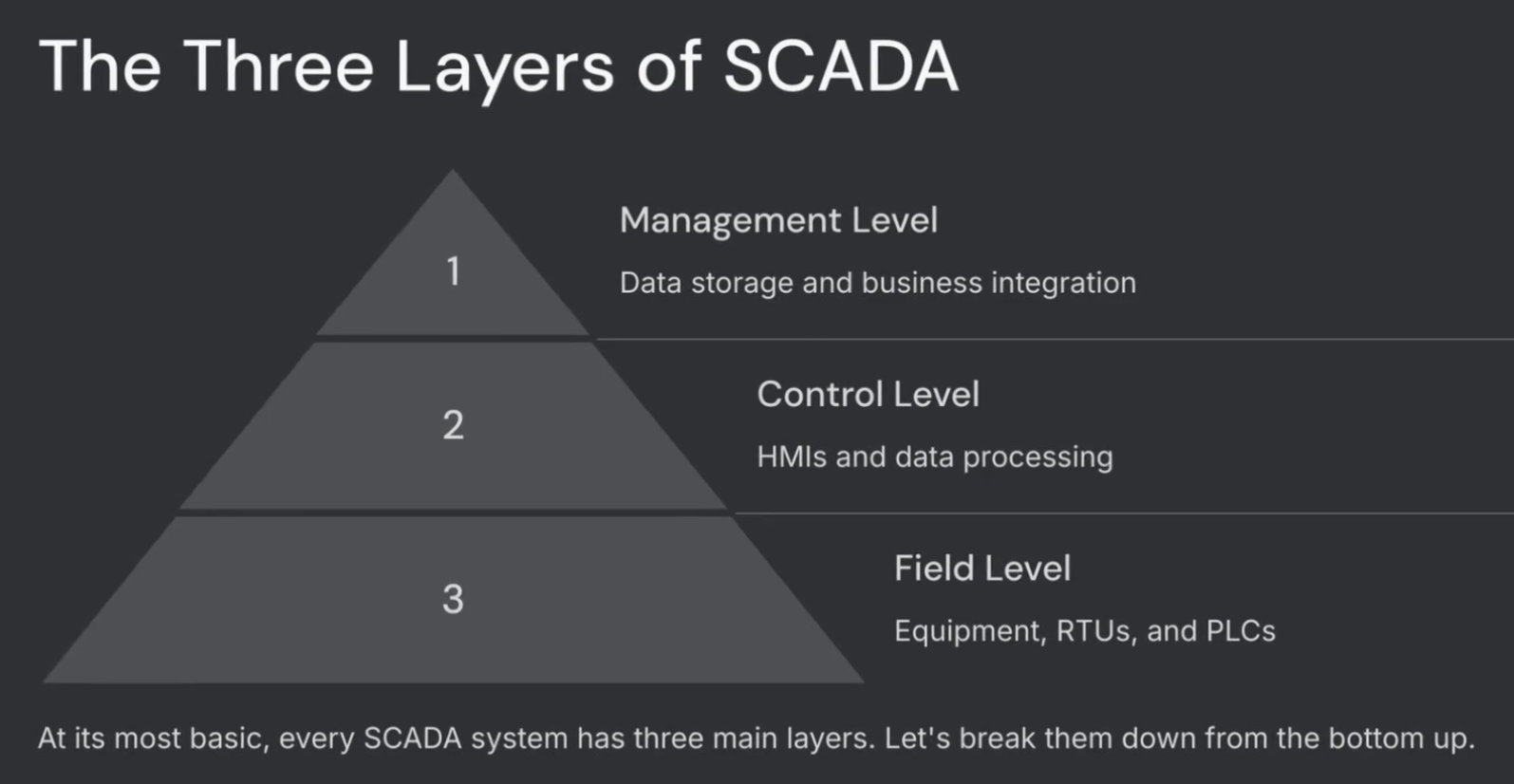
What is SCADA (Supervisory Control and Data Acquisition)?
- Supervisor/operator in control room can control the equipments (turn on/off)
- Technical equipment data acquisition and storage and basic analysis for operators.
- Hardware – sensor data acquisition and control
- Software – remote server at the control room to collect and analyze data
- Network to connect hw and sw. Usually satellite or wifi networks
Backbone of process automation.
4 broad ways
- If SAP system, then use SAP connector to get data into pub/sub. SAP is translator which translate scada file to sap understandable format ie json file
- Use Partners like Litmus and ClearBlade
- Industry standard communication protocol – software that uses this protocol to get data from scada and push to pubsub
- Python script, scaling can be issue – connect scada and pubsub to GCS for batch load – SFTP(GCS SFTP or DIY) or storage transfer (install gcp transfer agent at scada to transfer)
References